
Report: Programmer Meeting 13.05.2026
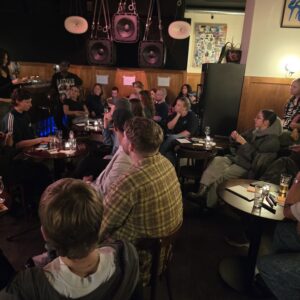
On 13th May, night-makers from all corners of your favourite city came together again. This time at Shunter; the newest addition to Rotterdam's nightlife. The agenda included the themes of Social safety and the Night agenda. The evening was well-attended by around 45 visitors. Together we were given a tour of the building and the outdoor area, where the contours of a great place to dance and meet are slowly beginning to take shape.
The break-outs were organised in collaboration with De Veilige Nacht and Rotterdam Festivals.
Breakout Social Safety
During the Social Safety breakout session, we explored the different perspectives on safety in nightlife. The focus was on discovering the extent to which Rotterdam night-life makers are involved with social safety, and how they are – or remain – informed. What works, what are obstacles, and how can we overcome those obstacles?
Based on experiences and existing safety protocols in clubs, one thing quickly became clear: safety doesn't mean the same thing to everyone. This depends on who you are, but also on the role you're fulfilling at that moment. While some associate safety with physical security, such as the routes to emergency exits and fire doors, for others, safety is something that can be experienced physically and situationally. This made it clear that safety cannot be merely captured by fixed rules but moves as a fluid dynamic between organisers, visitors, and staff.
Social safety revolves around feelings and the space people experience to be themselves. Measures in this area are aimed at giving visitors that feeling. But what is experienced as safe differs greatly from person to person; what feels like protection to one person can be experienced as a threat – or a restriction – for another. What do you do with extreme expressions and needs? As an organiser, you want to make room for both perspectives, while knowing they will never fully align. How do you take that into account? And how do you even find out that someone feels safe, or unsafe, in the first place? And do people feel safe enough to share their story, and if so, do they know where to do that?
To investigate this, we mapped existing safety protocols. Awareness teams regularly reappeared within these, as part of the organisation of the event or venue, and are trained to make space for experiences on the dance floor. At the same time, it became apparent that creating this space is not a given in practice. Not everyone feels safe enough to report something, and if something is perceived as minor, the question is whether you would say anything about it at all. That threshold is worth further investigation and could be pursued by also offering space after the party, possibly in the form of some sort of aftercare.
Furthermore, it emerged that the ideas behind safety can sometimes clash. Awareness teams and security operate from different logic, and can therefore still learn a lot from each other. It also came up that awareness of the different perspectives and needs on the dance floor can be guaranteed by community building. For example, there can be house rules for the club, such as how to treat the space and each other, but these can also vary per event taking place. Each party or event brings its own community. By making agreements together as a community about manners and values, you create a shared framework to fall back on when needs or tensions arise during an event. A joint moment before the start to go through the guidelines and discuss what everyone needs can already mean a lot in this regard.
There are a fair number of protocols and ways to ensure social safety, the big question in this process, however, is how this can be sustainably maintained. How do we actively pursue these values? And how do we fund this effort? There is a need for a working structure from which we can grow and learn from each other. For that, money and space are needed, and these are not always available. That is why we must do it together, because social safety is not only the responsibility of organisations, but visitors can also actively contribute to it. Check in with each other, keep an eye on each other, and remember: consent = sexy.
Breakout Night Agenda
During the Nachtagenda breakout session, visitors discussed what a Rotterdam night-time agenda should look like. Two consecutive sessions explored what is currently missing from nightlife, how people find and promote events, and what role a joint agenda could play in this. It quickly became clear that there is a need for more overview, but also for a platform that reflects the diversity of Rotterdam's night culture.
One of the biggest points of discussion revolved around the tension between completeness and curation. Some visitors emphasised the importance of a complete overview of all events, genres, venues, and communities. At the same time, it was mentioned that a completely unfiltered offering can quickly become confusing. Others saw more value in a curated agenda with recommendations from programmers, creators, or tastemakers, but this immediately raised the question of who decides what is visible and what isn't. The risk of gatekeeping was mentioned several times. A potential solution was found in a hybrid form: a complete overview as a basis, supplemented with tips, filters, and personal recommendations.
The question of what a 'night agenda' should precisely encompass also led to much discussion. For some, the night revolves exclusively around events after 11 PM, while others advocate for a broader approach to night culture. This included not only club nights, but also festivals, exhibitions, workshops, masterclasses, and other cultural activities connected to nightlife. Several visitors indicated that the agenda should be broader than just electronic music. Hiphop, Latin, jazz, Afro, queer events, and other scenes should also be visible within it.
In addition, there was extensive discussion about the way people discover events nowadays. Word-of-mouth advertising still played a significant role, as did Instagram, WhatsApp groups, and platforms such as Resident Advisor. At the same time, it was mentioned that social media feels fragmented and that an overview is lacking. Visitors therefore also spoke nostalgically about flyers, posters and stickers around the city, with a clear call to bring back physical promotion in the urban landscape.
In the development of a possible agenda, diverse wishes emerged. There was a need for clear search and filter functions, personal pages with saved events, options to follow favourite artists, genres or clubs, and information on matters such as accessibility, night transport and social safety. The discussion also covered features that would allow visitors to indicate that they are attending an event, similar to old Facebook events, making the social aspect of going out more visible.
At the same time, it became clear that ease of use is essential. A complicated app or a cluttered website would be counterproductive, according to many attendees. The programme must be intuitive, accessible and visually appealing, with a look and feel that suits the night. It was also emphasised that the platform should not only offer a practical overview, but also convey something of the atmosphere, identity and communities of the Rotterdam night.
Throughout the discussions, it became clear that the need for connection is significant. Not only between visitors and events, but also between organisers themselves. For example, the idea was raised to develop a backstage environment for programmers, so that events can be better coordinated and mutual competition is reduced. Ultimately, the breakout was therefore not solely about an agenda, but about the broader question of how Rotterdam's nightlife culture can be made more visible, accessible, and better connected.
Would you like to reread the reports on these break-outs?
– Social Safety Break-out Reporting
– Reporting break-out Evening agenda


 English
  Dutch
Dutch