Report: programmer meeting Sonoor 16 September 2026
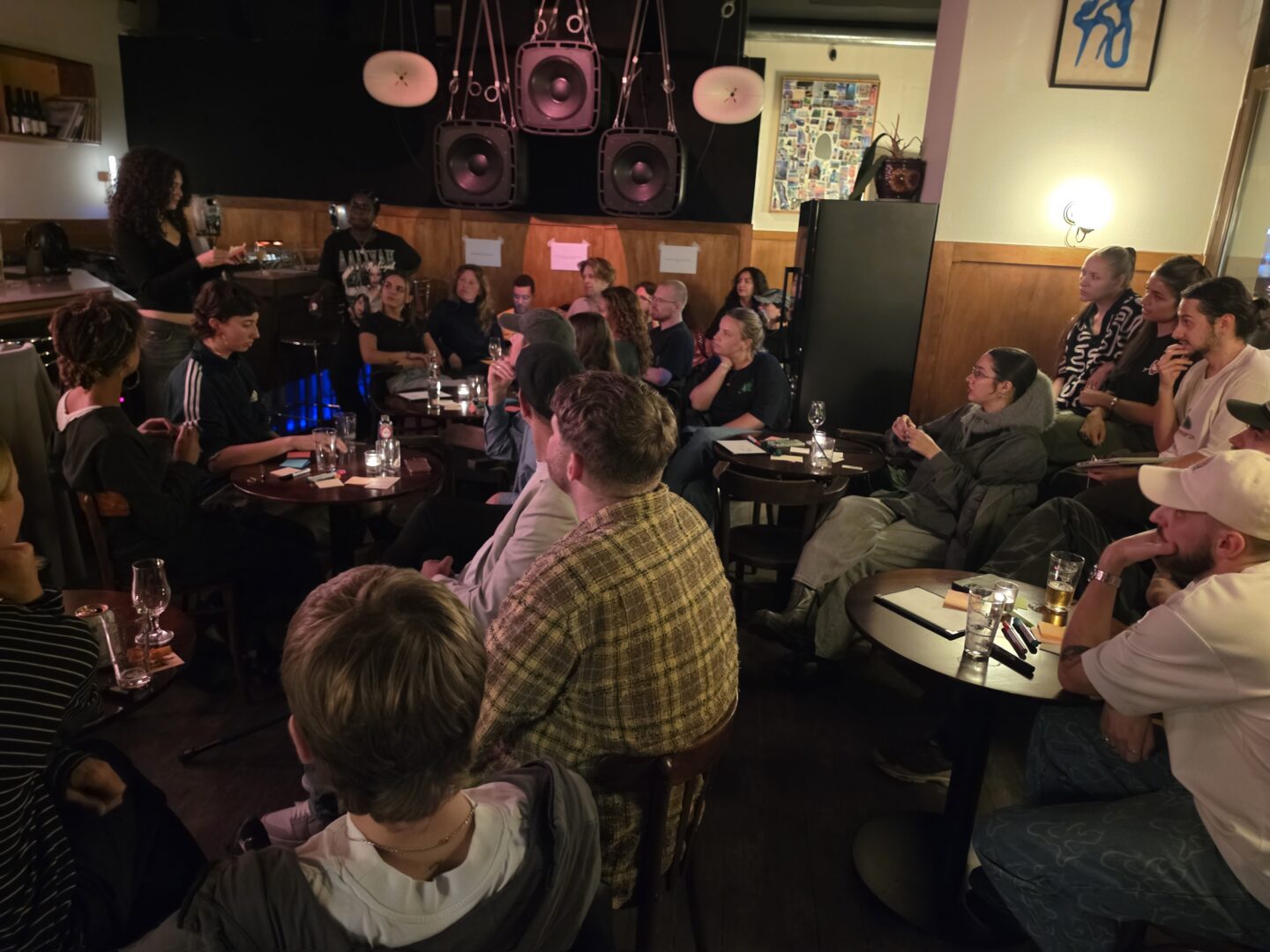
Money has to dance! Roll over that dance floor! But where exactly does it roll? Last Wednesday, September 16, 2026, we gathered with about 35 programmers and creators from the city at the listening bar Sonoor. After the walk-in, everyone took their seats at the cozy tables inside the cafe, with acquaintances and new faces mingling together. The members of the N8W8 R’dam, the municipality’s Nightwatch Service, and invited experts also mingled among the attendees.
For a long time, we have been hearing noises from the media about the younger generation going out less. One of the most important reasons mentioned is money. An evening out costs too much, from ticket to drinks. On the other hand, we hear from organizers how difficult it is to make ends meet when organizing events. The risks are too great and the rewards not enough. The nightlife scene of 2026 sometimes feels financially inaccessible from all sides. Is this feeling of impenetrability true, and where are the pain points? We decided to dedicate this programmer meeting to the financial accessibility of Rotterdam’s nightlife culture, with two breakout sessions.
Before we started, attention was paid to the physical accessibility of the nightlife. Willem Philipsen from Rotterdam Onbeperkt came to tell that the municipality is freeing up money from the Department of Urban Development to grant 10 free ski slopes in the city. The locations with the most online votes win the competition, so spread the word and get that ski slope! Follow when the campaign goes live via the municipality’s channels (and we’ll of course share some of that too).
Part 1: Financial accessibility
To get into the oil business, we started with the following questions: how much is too much for an evening out and how much do you have left after organizing an event? On average, the cost of an evening out is around 70 euros, although there were outliers that reached 100 and 150 euros. The amount that remains after an event also fluctuated significantly among organizers themselves, but some indicated that they would be left with 0 euros, while others averaged 1000 euros. A few even ended up with a significant deficit.
Financial pressure
Where is the pressure then? The financial pressure in Rotterdam nightlife is felt in various places in the chain. Staff costs are most often mentioned, along with location and rental costs, security, production costs, and artist fees. The risk for independent organizers is also highlighted when ticket sales fail or an event does not sell out. The ratio between the lineup and room capacity plays a role here: high costs combined with a limited number of visitors. In addition, ticket prices and disappointing presales are mentioned as important financial bottlenecks. With this in mind, financial accessibility seems to be not only a matter of what visitors can afford, but also of the broader cost structure within which nighttime events are organized.
Solutions
The proposed solutions fall into three categories:
1. More public support: more municipal subsidies, financial support for organizers and venues, and even (partial) assumption of rental or event costs by the municipality. But reasonable cost-of-living (free public transport and fair rental prices) was also a topic.
2. Lower costs for visitorsLower ticket prices, student discounts, a Rotterdam night pass or more opportunities to access clubs with the RotterdamPas. Free or pay-what-you-can events were also mentioned.
3. More space and a more fair distributionMore available buildings as venues, bringing back Thursday nights, and especially fair compensation for everyone.
A recurring underlying point is that nightlife is seen as something that has public and cultural value and therefore should not solely depend on commercial revenues from ticket sales and bar sales. So: more financial and institutional recognition of Rotterdam’s nightlife, and thus an improvement in affordability for visitors.
Part 2: Reader grant
This breakout started again with a small survey: who has ever applied for a subsidy? And who actually received it? The number of applicants was relatively low, and the subsidies actually received amounted to 2. The break-out shows that grant applications are perceived by many participants as complex, abstract, and lacking in intuition. Attendees indicated that they do not know where to start, that there are many different funds and conditions, and that it is difficult to determine which scheme suits their initiative. It is also mentioned that writing multiple applications requires knowledge of, among other things, finance, marketing, and formulating plans.
A second recurring bottleneck is the distance between the applicant and the reviewer. Respondents sometimes experience a lack of cultural understanding or understanding of the nightlife industry. The assessment is also perceived as abstract and there is a need for more transparency regarding why applications are granted or not.
Solutions
There is therefore a great need for practical support: templates, sample applications and approved applications, a clear grant guide or grant generator, and a contact point for feedback. Help from experienced grant applicants is also mentioned. N8W8 could play a role in this by, for example, facilitating a community, network, or roleodex (who knows?).
In addition, there is a need for smaller and shorter-term subsidies so that initiatives can apply for funding more quickly and with fewer administrative burdens. The Night Desk is mentioned as an existing place for advice.
At the same time, scarcity remains a major problem. Much more is requested than is available; a separate night category (“Night Culture”) could improve the connection, but it does not solve this shortage.
In summary, the need seems to lie primarily in more oversight, guidance, transparency, and arrangements that better align with the practice of nightlife. The responses suggest that access to subsidies is not just about making more money available, but also about simplifying the path to that money: knowing where to go, understanding what is required, being able to get help with the application, and understanding the evaluation process.



 English
  Dutch
Dutch